News and events
Warning: the bridges connecting you to your distribution partners may contain duct tape
Building integrations that last.
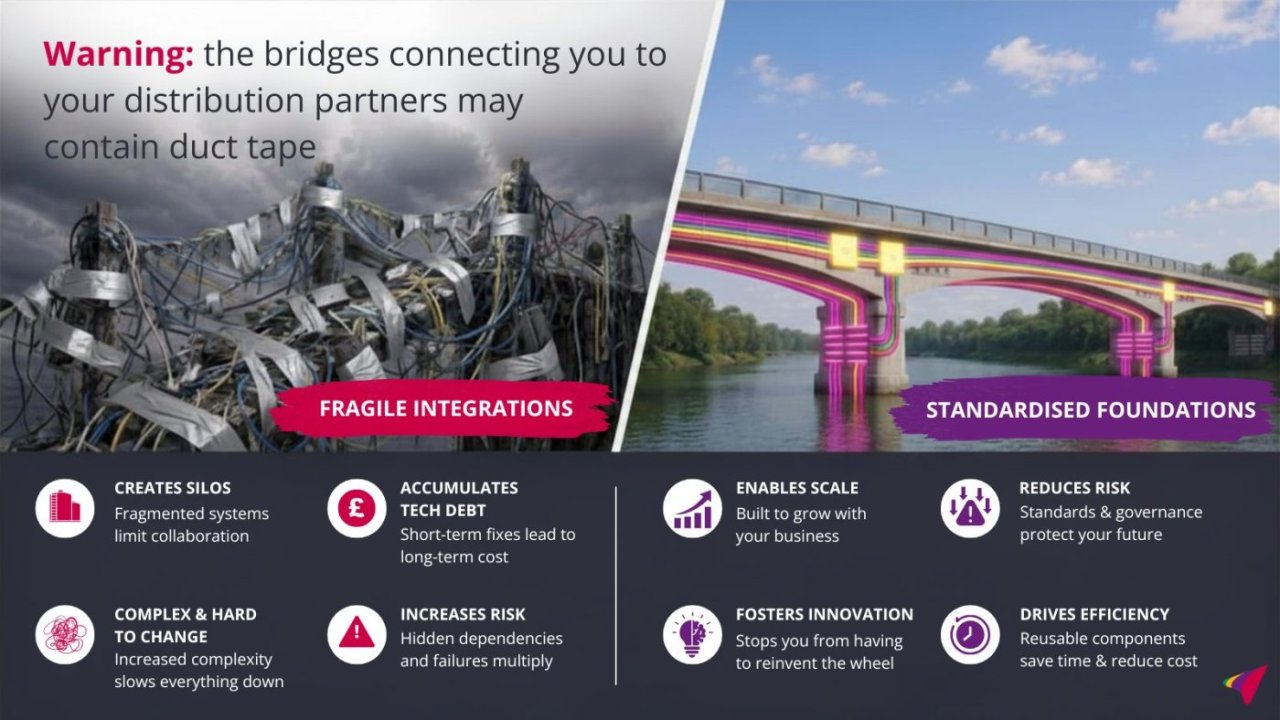
Integrations power our industry – they’re the bridges that connect systems, share data, and deliver real impact. But all too often, those bridges are built with duct tape and string. Rushed, isolated, designed to get today’s job done, rather than stand the test of time. And for a while, it works. The demo looks great. The client is happy. Job done.
The reality of fast-and-loose platform integrations
Then reality hits. Fragile foundations mean code that buckles under real-world pressure. Rigid designs create solutions that break the moment requirements evolve. Every "unique" build quietly adds complexity for everyone else, while ongoing fixes and firefighting consume any time saved upfront - eroding long-term efficiency. And every regulatory or legislative change becomes another unplanned expense.
Cracks appear, systems falter, connections wobble, and maintenance demands spike. What felt like a smart shortcut soon becomes a worrying liability.
The power of a shared standard
But there's a better way. One built on shared standards and full industry collaboration, bringing tech suppliers, platforms and everyone else to the same table, to create integrations that can scale and stand the test of time. When integrations are built on industry standards, shaped by the very people who use them, the results speak for themselves.
New connections - whether platforms, back-office systems or beyond - can be added with minimal effort. For platforms and their target adviser software partners, it means instant compatibility. Testing is consistent across the board using one set of criteria not ten, and every update or improvement benefits all adopters.
Standards power innovation
Here's where it gets interesting. Because when you're not rebuilding the same integrations from scratch or firefighting the last ones, something shifts. Your team stops reinventing the wheel - and starts inventing things that are new. The engineers, developers and product managers who were buried in maintenance and compatibility fixes get to work on problems worth solving.
Standards don't constrain what you can build - they clear the ground to build it on. Think of them as the engineering beneath a great bridge: the stronger the structure, the more confidently you can build upon it. Custom features that differentiate your platform. Value-added services that delight your customers. Ideas that were always on the roadmap, perpetually pushed aside by the weight of technical debt.
In an increasingly homogeneous market, this is important. The platforms that will thrive are not the ones that built the most integrations - they're the ones that laid the strongest foundations, then had the time, energy and resource to innovate on top of them.
The Platform Account Opening (PAO) standardised integration
So, what does this look like in practice? For many platforms, the answer starts at the very beginning of the client relationship: account opening. It’s one of the most integration-heavy processes a platform manages – and one of the highest-stakes. Get it wrong, and you risk delays, drop-offs, and a poor first impression at the most critical moment. Get it right, and you unlock faster onboarding, smoother distribution, and a scalable foundation for growth.
We have been collaborating with leading organisations (aberdeen, Aegon, Aviva, Embark Group, Iress, LV=, MoneyInfo, Origo, Quilter, Time4Advice, Transact, Woven Advice and Zurich) to develop a shared, industry‑agreed approach to this business-critical process.
Rather than organisations solving the same problem in slightly different ways, the PAO Standard gives the industry a solid common foundation. This reduces duplication, improves reliability, and removes many of the “back to square one” moments that typically arise when onboarding new partners or adapting to change.
The impact of building this way is clear: lower long‑term integration spend, quicker access to new distribution opportunities, and a scalable solution that keeps pace with changing regulation, market dynamics and customer expectations – without adding to technical debt.
They're quality-assured, expertly governed, and built to last. After all, the strongest bridges aren't the ones that went up the fastest - they're the ones still standing.
If you’d like to explore how the PAO Standard could work for your organisation, get in touch at [email protected].

